The next pass starts before the ball arrives.
Five useful reads for youth soccer coaches: receiving, purposeful possession, practice design, sleep and food.
In Legia Warsaw’s published U10 session, around 90% of the work takes place in game-based activities. The point is to give young players something to notice and a decision to make. That number describes the club’s approach; it is not a target every team needs to copy.
Welcome to ULTRAIN Field Notes. Each issue turns five worthwhile reads into things you can use with your team. Today’s edition connects three 2026 coaching examples with practical sleep and nutrition guidance. Pick one change, try it at practice, and watch what your players do.
Published 2026-08-25
Give the shoulder check a job.
Ask what the player saw, then watch what they choose.
Legia’s U10 practice connects looking over the shoulder with a choice: turn into space or return the ball to a teammate. The defender’s position makes that information useful. A player who looks but always makes the same turn may still be following a memorized pattern.
Use ULTRAIN’s Pass, Receive, Turn Box to introduce the movement. Its harder variation adds a passive defender; its easier variation lets the receiver pass back. Keep those choices clear. Between turns, ask one short question about where the pressure was. Give the player time to answer before supplying your own solution.
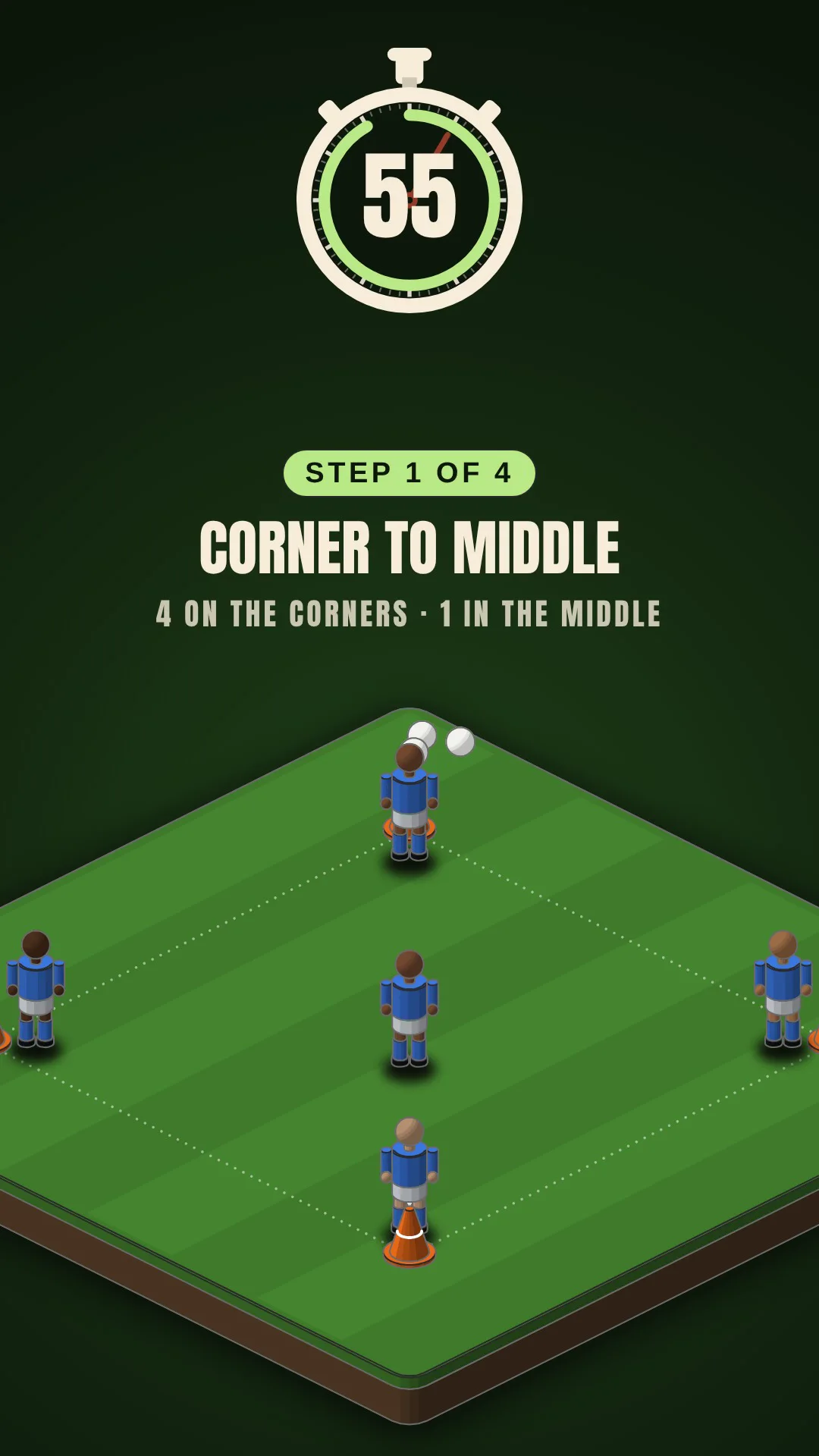
Try it on the field
Pass, Receive, Turn Box
- Corner to middle
- Turn and find the far corner
- Make it harder
- Make it easier
Try this at your next practice
- Show the two available choices before starting.
- Praise the decision as well as the first touch.
- Rotate the receiver so everyone gets a turn.
Keep in mind: This is a documented coaching approach, not a trial proving a particular improvement in scanning.
Give possession a destination.
Choose a scoring rule that rewards the action you want.
Christchurch United’s published U12 session moves into directional games with three players on each side and two support players. Players need to find space, offer a passing angle and progress the ball. Keeping possession is useful because it helps them reach somewhere.
ULTRAIN’s Split Rondo uses a different, simple target: one point for a completed pass and two for a pass between the defenders. The scoring tells players what to look for without requiring them to force every ball through the middle. Watch whether the players away from the ball move to open that route.
Let the group play before adding another rule. If they lose possession immediately, make the task easier. If they succeed comfortably, use the harder version in the drill.
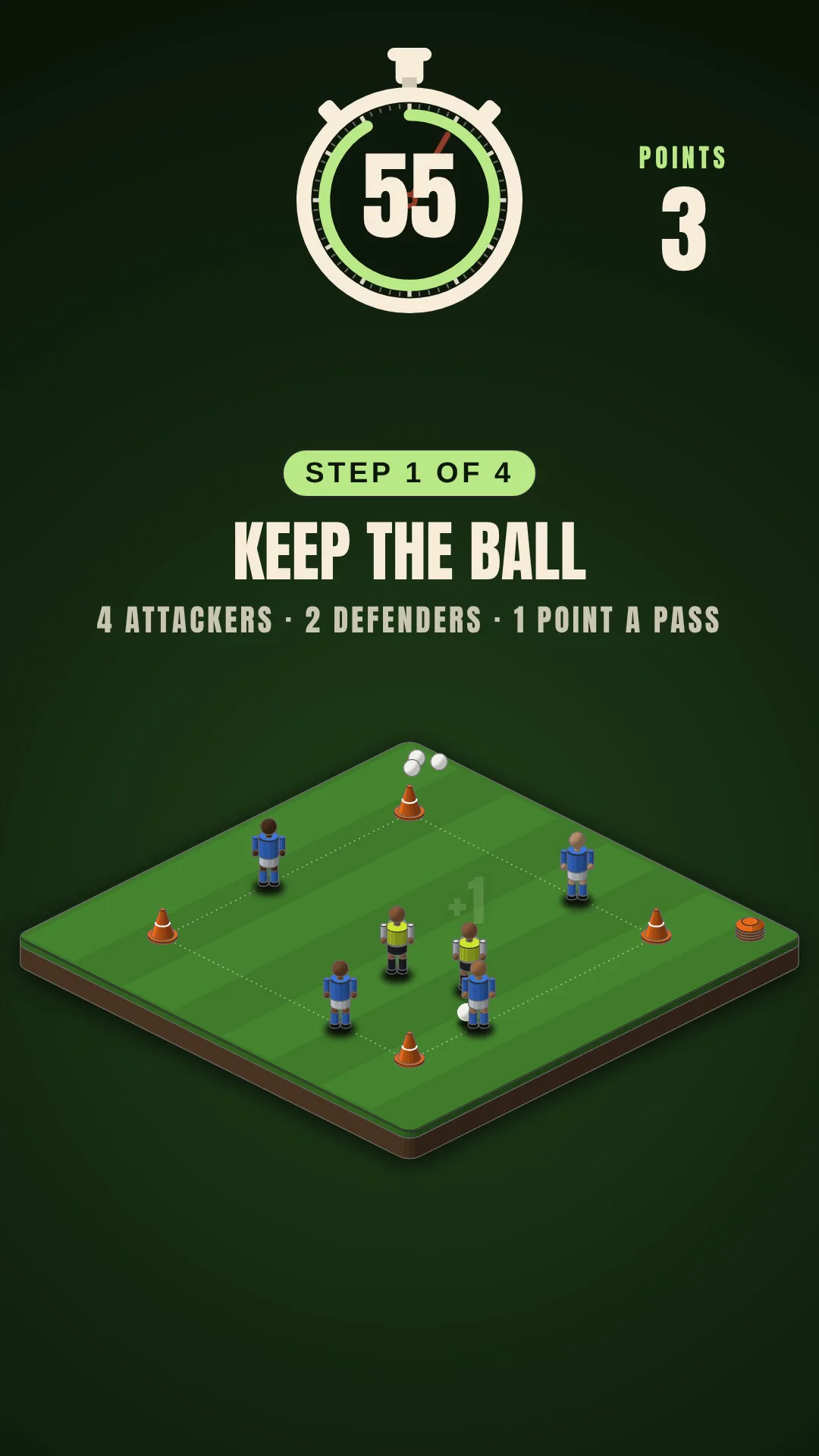
Try it on the field
4v2 Split Rondo
- Keep the ball
- Split the defenders
- Make it harder
- Make it easier
Try this at your next practice
- Name the action the score is meant to reward.
- Change one condition at a time.
- Ask players which movement created the opening.
Keep in mind: The ULTRAIN rondo is a related practice, not a recreation of Christchurch’s session or proof that one scoring system is best.
Carry one problem through the session.
Rehearse it. Add a defender. Look for it in a game.
FIFA’s 2026 position-specific framework uses three connected phases: individual actions, opposed situations and larger games. It also names the trade-off. Unopposed practice provides repetitions, but it cannot reproduce the choices created by a real opponent.
For a grassroots team, choose a manageable problem such as receiving with pressure nearby. Start with enough repetition to understand the action. Add opposition when players are ready. Finish with a game where you can see whether the same action appears without constant instruction. You can move back a step if the task becomes too difficult.
ULTRAIN’s Play Through Pressure plan connects first-touch work, possession and a small-sided game. Use its structure, then adjust the space, pace and challenge to the players who actually arrive.
- 1RepetitionsTry the action
Repeat a pass, turn or finish.
- 2OppositionRead the pressure
Add a defender and a choice.
- 3GameUse it in play
Keep the decision in a game.
Try this at your next practice
- Write one observation to look for in the final game.
- Keep that focus when you change activities.
- Ask the players what helped them solve it.
Keep in mind: FIFA’s original framework concerns talent development. This is a grassroots adaptation, not a reason to assign young children fixed positions.
Published 2026-05-06
The session ends when the players can go home.
Protect the time between practice and the next school morning.
The American Academy of Sleep Medicine recommends 9–12 hours of sleep per 24 hours for children aged 6–12, and 8–10 hours for teenagers aged 13–18. These are established health recommendations from its 2016 consensus, not a new soccer-performance experiment.
A coach cannot set a family’s bedtime. You can control whether the advertised finish time means players are leaving or starting another team talk. ACSM’s youth-athlete guidance identifies late training and travel among the things that can squeeze sleep.
Check the practical schedule with parents: the trip home, food, homework and school start time. A late session may need a different arrangement from a weekend morning. Treat that conversation as planning, without asking children to share private health information in front of teammates.
- Ages 6–12
- 9–12 hours
- Ages 13–18
- 8–10 hours
Try this at your next practice
- Give families a reliable pickup time.
- Finish announcements before that time.
- Raise persistent sleep concerns privately with a parent.
Keep in mind: Sleep needs vary. Families should discuss persistent sleep difficulties with their child’s healthcare professional.
Published 2016-06-15
Publication date not stated; checked November 19, 2026
Check the gap between lunch and practice.
Make food and water easy to plan for on busy training days.
In Children’s Hospital Colorado’s November 2026 guidance, sports dietitian Alex Roth describes inadequate carbohydrate intake as a common issue he sees. His advice starts with regular food, practical timing and hydration. This is clinical guidance, not a study showing how often ULTRAIN players are underfueled.
A useful coaching question is whether families have time and access to food between school and the field. Share the session length and expected finish time. Encourage families to plan familiar food and bring water, especially when dinner will be late. Avoid turning a team message into calorie targets, weigh-ins or supplement advice.
The American Academy of Pediatrics adds useful context: younger children doing light activity for an hour or less may not need an extra snack both before and afterward. Match the plan to the child and the activity.
- BeforeFamiliar food
Time to digest - DuringWater available
Planned breaks - AfterA meal or snack
Time to recover
Try this at your next practice
- Include water breaks in the session plan.
- Check allergies before arranging shared team snacks.
- Point families to a qualified dietitian for individual advice.
Keep in mind: A persistent energy problem deserves a conversation with the family and a qualified clinician; a coach should not diagnose its cause.
Publication date not stated; checked November 19, 2026
Pick one change for tonight.
For your next practice, choose one of the first three ideas and write down what you want to notice. After the session, record what happened and what you will adjust. One useful observation is a better starting point than changing every drill at once.
Published by ULTRAIN Sports. AI-assisted research and drafting, checked against the linked sources. Demonstrations and planning visuals are ULTRAIN examples; they are not images from the cited studies. Health information is general, not individual medical or nutrition advice.
Report a correction